
Record Lifecycle Management

Controlling Physical Records from Intake to Destruction
Healthcare and enterprise organizations face increasing pressure to secure, track, and properly dispose of physical records. Unmanaged paper files are not just an operational burden—they are a major compliance and audit risk.
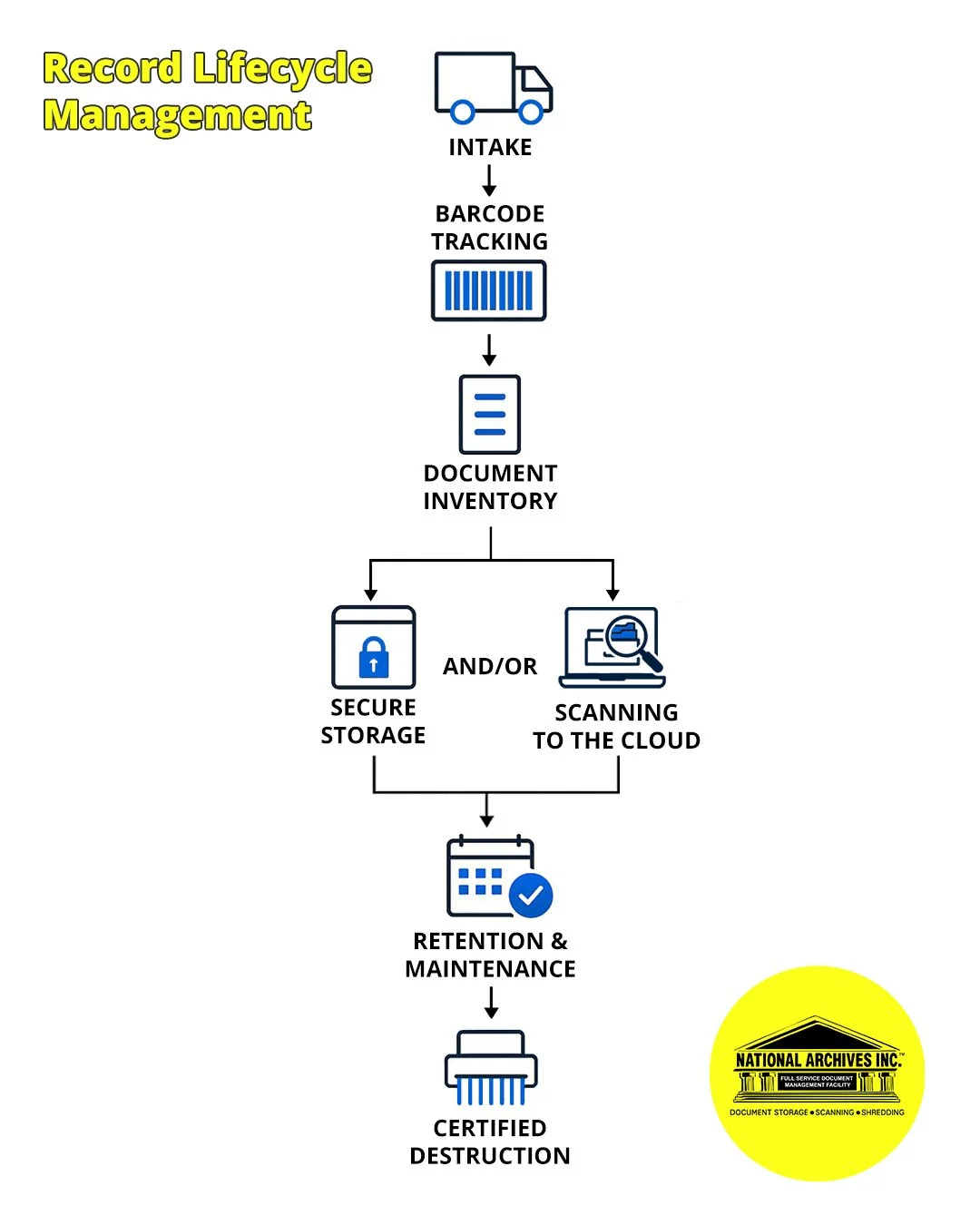
National Archives helps organizations manage the entire lifecycle of their physical records, from secure intake and barcode tracking to compliant storage, retrieval, digitization, and certified destruction. The result is full visibility, documented control, and confidence during audits.
What Is Record Lifecycle Management?
Record lifecycle management is the structured process of controlling every physical record from the moment it leaves your facility until it is securely destroyed.
A complete record lifecycle includes:
Secure intake and barcode tracking
HIPAA‑compliant offsite records storage
On‑demand retrieval or secure scan‑on‑demand services
Digitization as needed
Retention scheduling based on regulatory requirements
Certified destruction with documented proof of disposal
When implemented correctly, record lifecycle management transforms paper files from hidden liabilities into fully controlled, auditable assets.
Why Unmanaged Record Rooms Create Compliance Risk
During compliance audits, one of the most common findings is not weak digital security—it is uncontrolled paper records.
Auditors frequently uncover:
Boxes of records with no tracking or inventory
No documentation of who accessed sensitive files
Missing or unenforced retention schedules
Records stored well beyond legal retention periods
Confidential documents left in unsecured offices, closets, or basements
Professional organizations such as the American Health Information Management Association emphasize that physical records require the same level of governance as electronic records. Without barcode tracking, chain of custody, and retention enforcement, paper files represent one of the largest HIPAA exposure points for healthcare and enterprise organizations.
The Hidden Operational Cost of Paper Records
Beyond compliance, unmanaged physical records quietly drain time, space, and money every day.
Common operational challenges include:
Staff spending hours searching for charts or files
Valuable office space consumed by record storage rooms
Inefficient workflows between departments
Delays in patient care or business operations
Increased labor costs tied to manual retrieval and filing
Facilities and finance leaders increasingly recognize that eliminating record rooms and implementing professional offsite records management generates measurable cost savings while improving productivity.
What a Secure Record Lifecycle System Looks Like
A compliant and efficient record lifecycle management program includes several core components:
Intake - We work with you to schedule a convenient time to pick up your documents from your office or storage location.
Barcode Chain of Custody - Every box and file is uniquely barcoded and tracked, providing full visibility into location, access history, and movement 24/7 via Web Browser.
Secure Offsite Records Storage - Records are stored in monitored, access‑controlled facilities designed to meet regulatory and privacy requirements.
On‑Demand Retrieval and Secure Scanning - When records are needed, they can be delivered quickly or scanned securely—often the same day.
Digitization When It Makes Sense - Instead of scanning everything upfront, organizations can digitize records on demand or in planned batches.
Retention Scheduling and Compliance Oversight - Records are automatically tracked against retention requirements and flagged for destruction at the appropriate time
Certified Destruction - When records reach end of life, they are securely shredded with certificates of destruction to document compliance.
Why Organizations Choose a Record Lifecycle Partner
Hospitals and large enterprises no longer want separate vendors for storage, scanning, and shredding. They want one accountable partner responsible for the full record lifecycle.
Because when an audit issue arises, the question is not:
“Who stored this box?”
The question is:
“Who was responsible for this record?”
A single lifecycle management partner eliminates gaps, handoffs, and uncertainty—while simplifying compliance oversight.
From Record Rooms to Record Control
If your organization is dealing with:
Overflowing file rooms
Untracked offsite boxes
No clear retention schedule
Staff constantly searching for records
Concerns about HIPAA or regulatory exposure
It’s time to stop thinking about file storage and start thinking about document control.
Secure record lifecycle management protects your organization, supports your staff, and ensures audit readiness at every stage of a record’s life.
Contact National Archives Today
National Archives specializes in end‑to‑end record lifecycle management for healthcare and enterprise organizations.
From secure storage and tracking to digitization and certified destruction, we help you reduce risk, reclaim space, and stay compliant with confidence.
Contact National Archives today to discuss your record lifecycle challenges and learn how a fully managed solution can support your organization.